On the Origin of Species · ¶202
The accompanying diagram will aid us in understanding this rather perplexing subject. Let A to L represent the species of a genus large in its own country; these species are supposed to resemble each other in unequal degrees, as is so generally the case in nature, and as is represented in the diagram by the letters standing at unequal distances. I have said a large genus, because we have seen in the second chapter, that on an average more of the species of large genera vary than of small genera; and the varying species of the large genera present a greater number of varieties. We have, also, seen that the species, which are the commonest and the most widely-diffused, vary more than rare species with restricted ranges. Let (A) be a common, widely-diffused, and varying species, belonging to a genus large in its own country. The little fan of diverging dotted lines of unequal lengths…
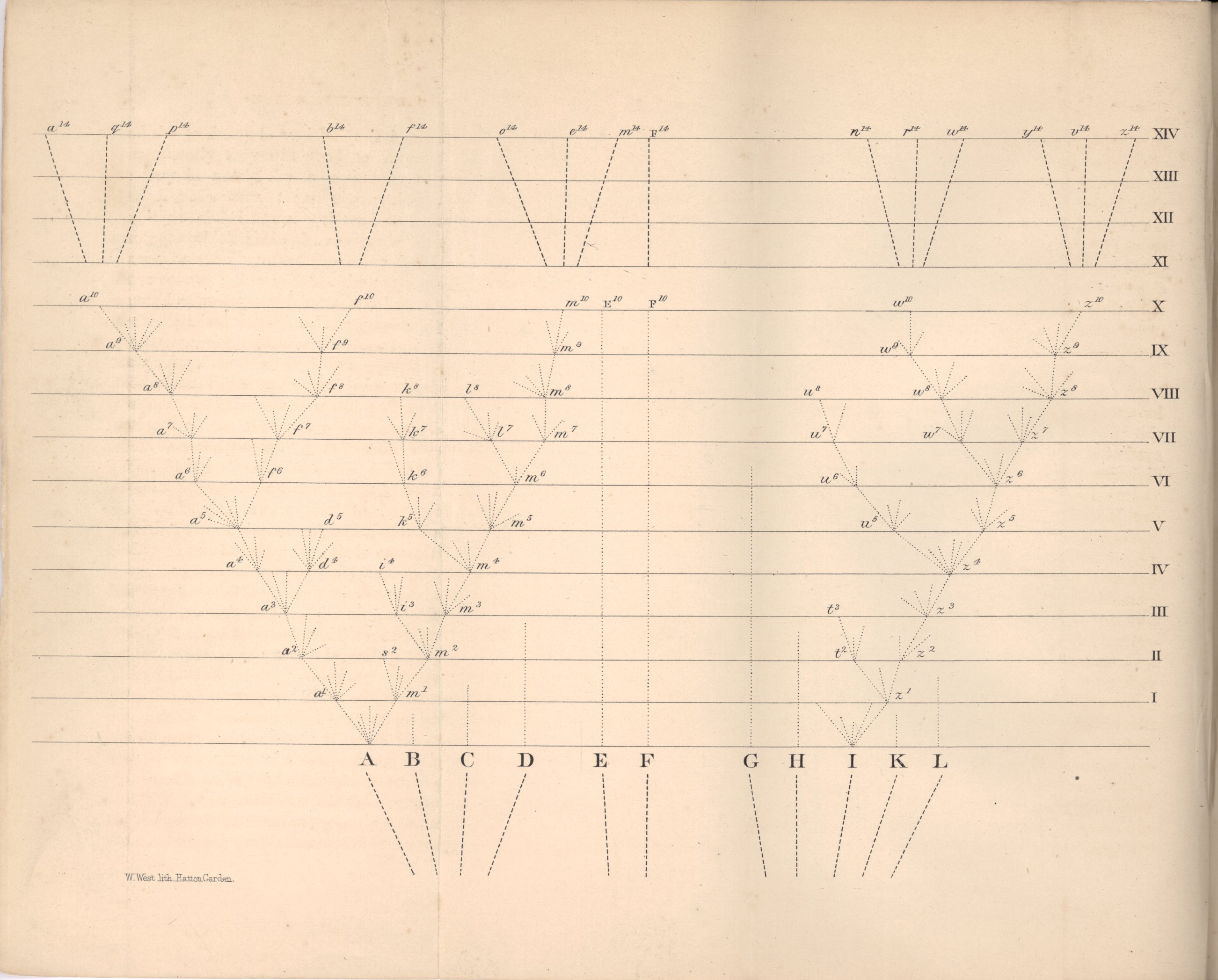
Original 1859 plate, supplied separately because Gutenberg #1228 omits it. No printed caption is present.
Charles Darwin · John Murray, London, 1859, first edition · Gutenberg #1228; original diagram from Darwin Online F373
Charles Darwin · John Murray, London, 1859, first edition · Gutenberg #1228; original diagram from Darwin Online F373
Passage preview. Read in context for the complete text, notes and references.